
 |
| MARK ROTHKO (currently on exhibit at Pace Gallery) |
I write in an effort to escape, if only for a short while, the intense agitation and despair that have engulfed me for most of the past year. I have no desire to dwell on the circumstances that brought us here, for that would provide no relief whatsoever. I know that for my emotional and spiritual sanity, I must regain some balance in my life. I cannot let my fears about the future of our country and the world overpower everything that makes life meaningful for me. At the same time, I fully recognize that our lives as Americans have been forever changed and that I cannot retreat from my engagement with the world.
It is through the arts, as well as the natural world, that I find solace, beauty, joy, humor, sadness, and brilliance. They have the power to surprise and provoke me. They remind me of what is good in the world.
Three current exhibits (all on view in New York through early January) have exerted a powerful hold on my emotions and remain very present in my thoughts. I don't presume to have any significant insights into the work of these three artists. I can only describe what I experience when in the presence of the work.
Apologies for the limited information in the captions. For the Rothko exhibit, the gallery did not make complete information about the paintings available to the public. For the works by Herrera and Martin, it is my own sloppiness in not having kept track of the information.
MARK ROTHKO: Dark Palette @ Pace (through January 7, 2017)
 |
| MARK ROTHKO |
For more information about the Rothko exhibit, click here.
 |
| MARK ROTHKO |
 |
| MARK ROTHKO |
 |
| MARK ROTHKO |
 |
| CARMEN HERRERA Paintings from the series Days of the Week |
In contrast with the introspective experience of the Rothko exhibit, Herrera's bold geometric abstractions brought me feelings of of joyful vitality. The exhibit focuses on just a thirty-year span, 1948-1978, in Herrera's very long life (she continues to paint at the age of 101!)
A wonderful suite of seven paintings from the late 1970s, Days of the Week, is installed on a long wall opposite the elevators. In keeping with Herrera's tendency to limit her palette, each of the paintings in this series is executed in black plus one other color. The offer up exuberance and clarity. I was also drawn to the very elegant Blanco y Verde paintings from the 1960s. This work is defined by a pared down, asymmetrical geometry and limited to green and white elements, which continually shift between figure and ground. In another room is a large group of Herrera's Estructuras--painted would sculptures, some mounted on the walls and others free-standing on the floor. The formal elements of these constructions sometimes parallel the geometry of her paintings, but here the interplay is between figure and empty space, rather than the figure / ground of the paintings.
For more information about the Herrera exhibit, click here.
For an article about the Herrera exhibit, click here.
 |
| CARMEN HERRERA Painting from the Blanco y Verde series |
 |
| CARMEN HERRERA Painting from the Blanco y Verde series |
 |
| CARMEN HERRERA From the Estructuras series |
 |
| CARMEN HERRERA Work on paper |
AGNES MARTIN @ Guggenheim Museum (through January 11, 2017)
 |
| AGNES MARTIN from a 1980s series titled Grey Paintings |
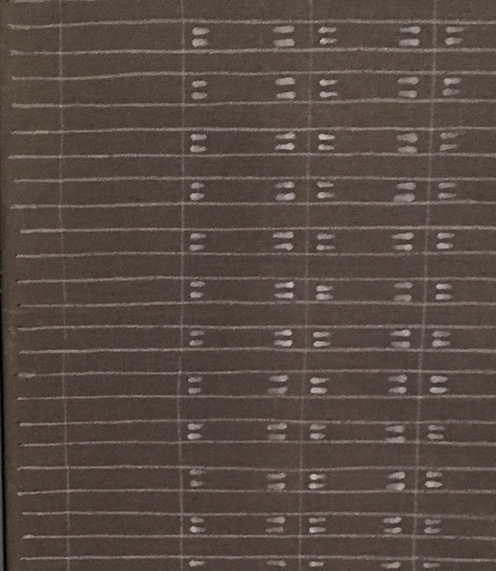
Since I am unlikely to offer any meaningful insights that would add to the discussion of Martin's work, I'll limit my comments to how I experience her work. As of this writing, I've visited this majestic and comprehensive exhibit three times and have only started to digest what I've seen.
N.B. The narrow black bands along the edges of some paintings are the frames and not part of the paintings.
What is immediately apparent is Martin's doggedness in pursuit of, step by minute step, the seemingly limitless variations that were possible within each 'theme' that captured her interest. Her repeated experimentation -- with infinitesimal shifts in palette, compositional structure, and mark making -- makes her paintings and drawings an endless source of pleasure for slow-lookers like me. The more time I spend with each work, the more I see. But I'm never certain if what I see is in the paint or is my perception of the paint -- pale, pale tints of colors appear and disappear, a very diffused light seems to gently move across the surface.
Another element of her work that grabs me by the gut is its tenderness -- when you move in quite close you can see the frailty of her pencil lines and the irregularity along the edges of her color bands. The mark of her hand is always present. What may appear to be a rigidly painted grid or a precisely drawn series of lines when viewed from a distance is transformed upon close examination. While the overall composition of Martin's mature work is generally quite restrained, the fields are filled with variegated grounds and stains. Clearly, the compositional framework suggests order, but the execution of each work suggests deep emotion.
For more information about the Agnes Martin exhibit at the Guggenheim, click here.
For more information about Agnes Martin Grey Paintings, click here.
 |
| AGNES MARTIN White Flower, 1960 (from the Guggenheim Museum website) |
 |
| AGNES MARTIN The Sea, 2003 |
 |
| AGNES MARTIN Detail from I love the whole world, 1999 |
 | |||
| AGNES MARTIN Detail from White Flower, 1960 (the color cast may be incorrect) |
 |
| AGNES MARTIN Untitled, 2004 |
 |
| AGNES MARTIN |
If looking at the paintings in this post has given you some comfort in this difficult time, then I have done some good. If this post sends you off to see the exhibits for the first time, or the fifth time, even better. If looking at these paintings gives you the courage to engage in the difficult work that lies ahead of us, I look forward to joining you in the streets.


